
Mercedes Coding: What You Can Unlock and How to Do It
What coding changes in a Mercedes-Benz, which functions it can unlock, when SCN coding is needed and which way of coding suits which owner.
Table of contents
- What Mercedes coding is
- Why features are switched off at the factory
- Features coding can switch on
- What coding cannot do
- SCN coding and online access
- Ways to code a Mercedes
- Dealer and specialist workshops
- Diagnostic software and coding apps
- Plug-in modules for one function
- Coding safely
- Dealer updates, warranty and the law
- Conclusion
Mercedes coding means changing the software settings of the control units in a Mercedes-Benz so that the car behaves differently: a function that was switched off at the factory starts working, a setting is remembered after a restart, or a menu appears that the car never showed before. Nothing is bolted on and no wires are cut. The car already has the hardware, and coding decides how it is used.
That makes coding one of the least expensive ways to get more from a Mercedes, and also one of the easiest to get wrong. What can be unlocked depends on the equipment of the individual car, some changes need online access to Mercedes-Benz servers, and the right tool depends on whether you want one function or full control over every control unit. This guide explains what coding can and cannot do and which way of doing it suits which owner.
What Mercedes coding is
A modern Mercedes has dozens of control units: for the engine, the transmission, the head unit, the instrument cluster, the lights, the suspension and the comfort functions. Each of them stores a configuration, a set of parameters that tells it which functions are active and how they behave. The factory writes this configuration for the market, the trim level and the options the car was ordered with, and coding changes it.
Three terms are often mixed up. Diagnostics reads fault codes and live data and changes nothing. Coding changes the configuration of a control unit while its software stays the same. Programming, also called flashing, replaces the software itself with a new version, for example during an update or after a control unit has been replaced. Of the three, coding is the lightest intervention, because only the settings change.
Engine tuning sits apart from all of them. A Stage 1 tune rewrites the calibration of the engine control unit to raise power and torque, so it is closer to programming than to coding, and MWMods offers it as a separate ECU Stage 1 module. Everything else in this guide is about switching existing functions on, off or into a different mode.
Why features are switched off at the factory
The most common reason is that an option was not ordered. Mercedes often fits the same hardware to every car of a series and enables a function only where it was paid for. Smartphone integration is the typical case: many cars have the head unit and the USB port for Apple CarPlay, but the function itself is switched off.
The second reason is the market. Rules for lighting and driver assistance differ between countries, so the same model leaves the factory configured differently for the US, Europe or Asia. The best-known example is the adaptive high beam of MULTIBEAM LED headlights, which was switched off on US-market cars even though the headlights are capable of it.
The third reason is the factory default itself. Some functions return to their basic setting at every engine start, whatever the driver chose last time: ECO start/stop switches itself back on, and DYNAMIC SELECT returns to Comfort. Coding can change this behavior so that the car remembers the driver's last choice.
Features coding can switch on
Which functions coding can unlock depends on what the car already has. The table lists the changes Mercedes owners ask for most often, the equipment each one needs and what changes in the car afterwards:
| Function | What the car must already have | What changes after coding |
|---|---|---|
| Apple CarPlay and Android Auto | NTG 5 or MBUX head unit and a USB port with the smartphone integration symbol | Smartphone integration appears in the menu and starts when the phone is connected |
| MULTIBEAM adaptive high beam | MULTIBEAM LED headlights on a US or Canadian car | The high beam stays on and masks oncoming and preceding cars instead of switching off |
| AMG menu in the instrument cluster | Digital instrument cluster | AMG pages with oil temperatures, boost, power and torque, and a lap timer |
| ECO start/stop last mode | ECO start/stop button | Start/stop stays off after a restart if the driver switched it off |
| DYNAMIC SELECT last mode | DYNAMIC SELECT switch | The car starts in the last drive program instead of Comfort |
| Suspension lowering | AIRMATIC air suspension | A lower ride height is stored in the suspension control unit, with the factory height kept for later |
| Exhaust flap selection | Factory AMG exhaust with flaps | The flaps open in every drive program, not only in Sport+ and Race |
| Comfort and display settings | Depends on the model and the control unit | Number of turn signal flashes, rear lights with the daytime running lights, display units |
The middle column is what decides. Lowering requires AIRMATIC, the AMG menu requires a digital instrument cluster, and MULTIBEAM functions require MULTIBEAM headlights. Because two cars of the same model can be equipped very differently, the VIN is the reliable way to check, which is why MWMods asks for it before preparing any module.
For the most requested functions MWMods offers ready modules: CarPlay and Android Auto, MULTIBEAM LED, the AMG cluster menu, ECO start-stop last mode, DYNAMIC SELECT last mode, suspension lowering and exhaust flap selection. Smaller comfort settings, such as the number of turn signal flashes or the acoustic lock confirmation on cars like the W204 C-Class, are usually changed by a coding specialist.
What coding cannot do
Coding works only with hardware that is already in the car. It cannot turn halogen headlights into LED units, add lane keeping to a car without a camera or create seat heating where there are no heating mats. If a control unit, sensor, motor or wire is missing, no setting will make the function appear.
The opposite is not automatic either. Having the hardware does not guarantee that every combination of settings will run: the part number, the software version of the control unit and the access rights the change requires all play a part. That is why a reliable answer for a specific car comes from its VIN and, for complex changes, from a diagnostic scan, not from a list of options found on a forum.
SCN coding and online access
SCN stands for Software Calibration Number. It is a data record confirming that the software and configuration of a control unit match the hardware and equipment of that particular car, and it is signed by Mercedes-Benz.
After a change, XENTRY, the dealer diagnostic system, requests the matching SCN from the Mercedes server. The server checks whether the configuration is approved for this VIN and returns a signed value, and the control unit accepts only that signed value. Coding offline, without this check, cannot complete the step.
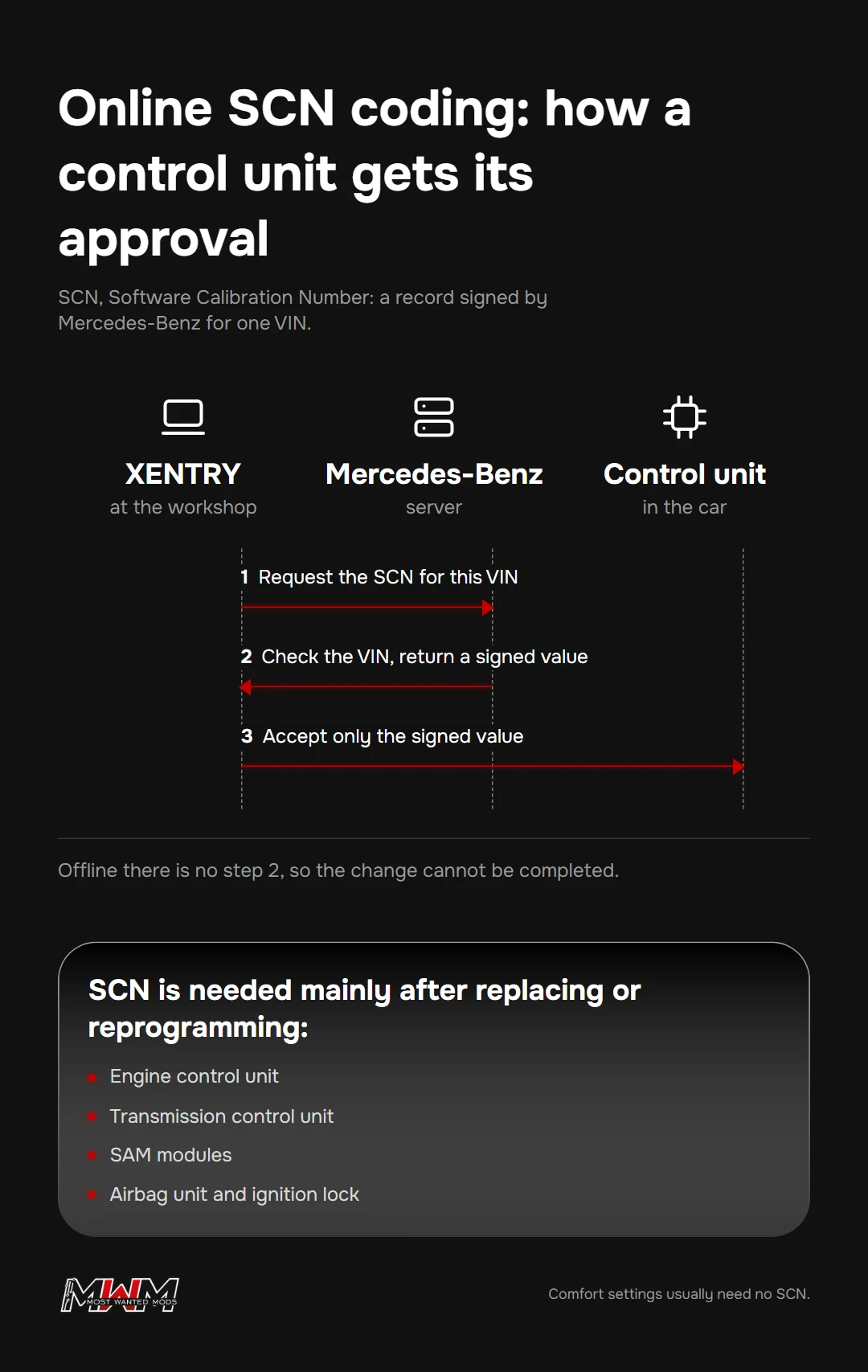
SCN coding is needed mainly after a control unit has been replaced or reprogrammed, not for comfort settings. It typically applies to:
- the engine control unit
- the transmission control unit
- the SAM modules that control lighting and power distribution
- the airbag control unit and the electronic ignition lock
Online SCN coding requires XENTRY with access rights to the Mercedes-Benz network, which dealers and authorized independent workshops have. Newer cars are tied to the Mercedes servers more closely than older ones, so more procedures can be done only online. Keys and the immobilizer form a separate, even more protected level, and adding a key or adapting a used control unit to another car remains a job for a dealer or specialist. Some repairs also include a coding step without SCN, such as entering correction values after replacing diesel injectors or registering a new battery, and the workshop does this as part of the repair.
Ways to code a Mercedes
There are three ways to change the coding of a Mercedes. They differ in how much they can do, what they cost and how much knowledge they expect from the owner.
Dealer and specialist workshops
A Mercedes-Benz dealer codes with XENTRY, the official diagnostic and coding system. It reaches every control unit, handles online SCN coding and follows the procedures approved for the car. The limitation is the scope: a dealer usually changes only what Mercedes allows for that car and market, and coding beyond the factory configuration is rarely offered.
Independent coding specialists work with dealer-level software and often go further: they unlock market-specific functions, configure retrofitted equipment and make custom changes. Some also code remotely through a device sent to the owner. Prices are set by each workshop, per function or per hour, and the result depends on the specialist, so reviews and a written record of what was changed are worth asking for.
Diagnostic software and coding apps
Owners who want to code themselves have two levels of tools. The first is the engineering software of the Mercedes-Benz environment, Vediamo and DTS Monaco. These programs give direct access to the parameters of every control unit and can both code and flash, but they have no protective limits, need a multiplexer to connect the laptop to the car and assume a solid knowledge of the parameters. A wrong value can disable other functions or leave a control unit in an error state.
The second level is phone apps that work with an OBD adapter, together with universal diagnostic scanners that include coding functions. They offer ready functions from a list, so the owner picks a function rather than a parameter. They are easier to use, but the list covers only what the developer has prepared for that model, many functions are paid for with credits or a subscription, and SCN coding is either missing or limited to certain control units.
Either way, coding on your own calls for care with the electrical system. Writing to a control unit can take several minutes, and a voltage drop or a lost connection halfway through can leave it only partly configured.
Plug-in modules for one function
A plug-in module is a device prepared for one function and one car. It needs no laptop, software or knowledge of parameters: the owner connects it to the OBD-II port, selects the function and applies it, as described in how a module is installed. The whole process usually takes a few minutes.
MWMods modules work this way. Each one is prepared after a VIN check for the specific chassis, engine and equipment, and it does not stay in the car after the change. The owner keeps it to change the setting again or to return to the factory settings. Prices are fixed per function and car: $240 to $300 for ECO start-stop last mode, $260 for CarPlay and Android Auto or DYNAMIC SELECT last mode, $260 to $300 for the AMG cluster menu, $350 for exhaust flap selection, $550 for MULTIBEAM LED and $550 to $900 for suspension lowering.
The trade-off is scope. A module does one job and does not replace a specialist for custom coding or a dealer for SCN coding after repairs. For the functions owners want most, it is the quickest route and the one with the least room for error.
Coding safely
Whatever the method, the same precautions decide whether coding goes smoothly. Specialists follow them on every car, and they matter just as much for owners who code themselves:
- Check the battery and keep the voltage stable; for longer sessions, connect a battery charger or power supply.
- Confirm by VIN that the car has the equipment the function needs.
- Run a full scan for fault codes and fix active faults before changing anything.
- Save the original coding of every control unit you are going to change, so the factory state can be restored.
- Leave safety systems such as airbags, brakes and steering alone, and finish with a second scan and a test of the coded function.
A short note of what was changed, in which control unit and when, is worth keeping as well. It saves time if a dealer update overwrites the setting or a later owner wants to know what was done to the car.
Dealer updates, warranty and the law
A software update at a dealer can reset coding, because the update writes the factory configuration back into the control unit. This is not a fault, and the change can usually be applied again with the same tool or module. It is worth keeping in mind before a dealer visit, especially for functions activated outside the dealer network. If Apple CarPlay no longer starts after such a visit, first rule out the phone with Apple's CarPlay connection checklist, then see our guide to CarPlay not working in a Mercedes.
Coding outside the dealer network can also affect warranty decisions. If a fault in a component is linked to a change in its configuration, the dealer may decline to cover that repair. Returning the car to its factory configuration before a warranty visit is a sensible precaution where the method allows it.
Rules on what may be changed differ between countries and between functions. Keeping start/stop off or remembering a drive mode is a different matter from changing lighting, exhaust sound or driver assistance, which can be regulated. If a change affects any of these, check the rules where the car is registered before making it.
Conclusion
Mercedes coding changes the settings of control units, not the hardware, so it can unlock only what the car already has. Most popular changes, from CarPlay to a remembered drive mode, come down to switching on a function the factory left off.
For one specific function a plug-in module is the quickest and most predictable route, custom changes belong with a coding specialist, and SCN coding after repairs belongs with a dealer or authorized workshop. In every case, checking the car's equipment by VIN comes first.