
MULTIBEAM LED vs LED High Performance: Which Headlights Does Your Mercedes Have?
LED High Performance, MULTIBEAM LED or DIGITAL LIGHT? How the three Mercedes headlights differ, how to tell yours, and why US cars behave differently.
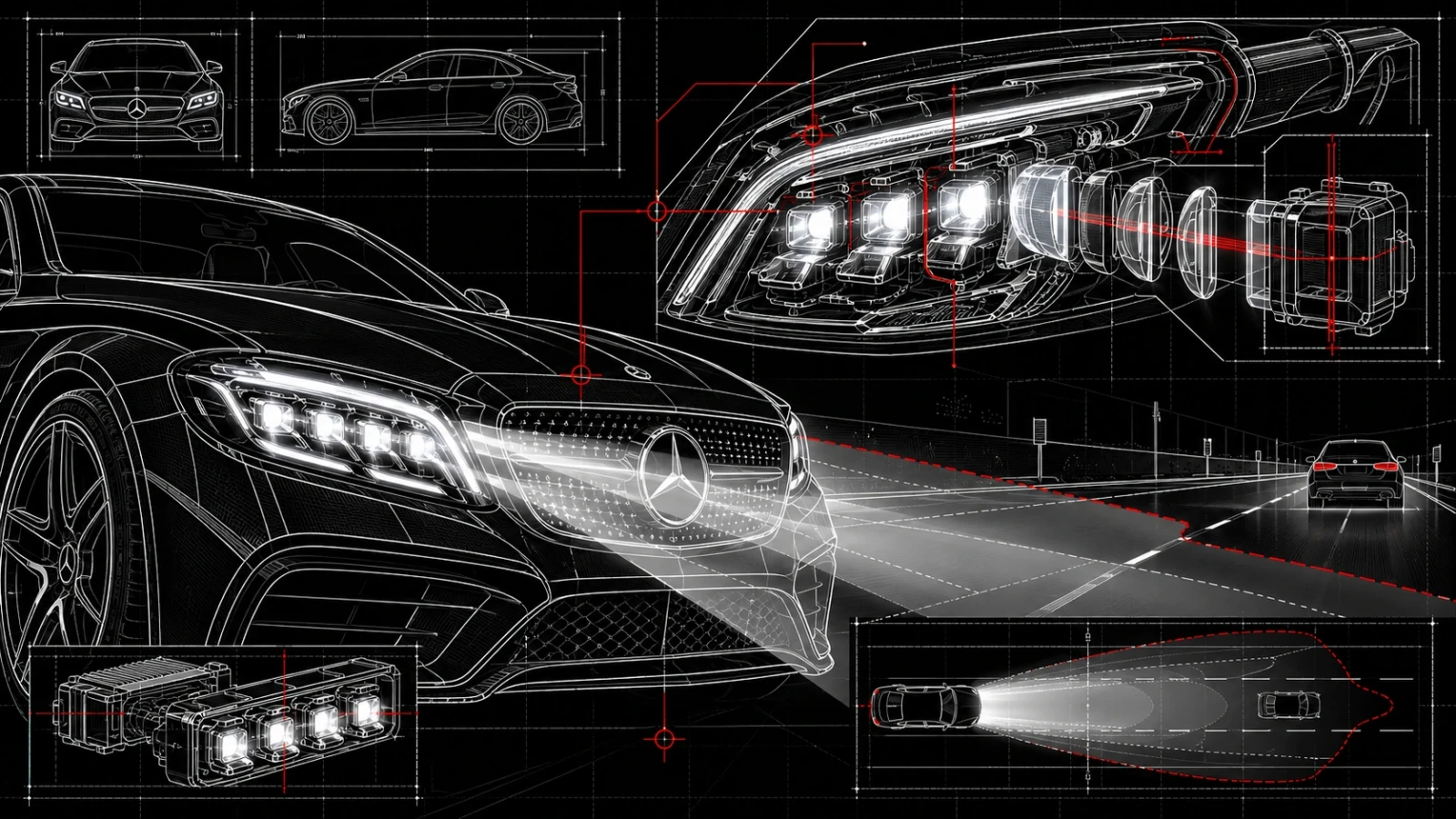
Table of contents
- How MULTIBEAM LED works
- Camera and control unit
- Individually controlled LEDs
- MULTIBEAM functions for the driver
- Mercedes-Benz LED headlight types
- Night driving with each headlight type
- On an empty road
- With oncoming traffic
- Mercedes models with MULTIBEAM LED
- Checking which headlights your car has
- MULTIBEAM on US-market cars
- Activating MULTIBEAM functions later
- Cars with MULTIBEAM LED hardware
- Cars with LED High Performance
- Conclusion
Mercedes-Benz has offered three kinds of LED headlights over the last decade, and from the outside they can look almost identical. The difference shows up at night, on a dark road with traffic: some headlights can only switch the high beam on and off, while others keep it on and dim just the part that would dazzle other drivers.
Below: how MULTIBEAM LED works, how it differs from LED High Performance and DIGITAL LIGHT, how to find out which headlights your car has, and why the answer is more complicated on cars built for the US market.
How MULTIBEAM LED works
A MULTIBEAM LED headlight is not one lamp with two settings but a set of small light sources that the car controls one by one. Two parts make this possible: a camera that sees other road users and LEDs that can be switched individually. Both have to be present and active for the headlight to shape its beam around traffic instead of simply switching it off.
Camera and control unit
A camera behind the windshield watches the road ahead. It detects oncoming vehicles, cars driving in front and their position in the image, and passes this information to the headlight control unit many times per second while you drive at night.
The control unit decides which parts of the beam to dim. Mercedes-Benz calls this function Adaptive Highbeam Assist Plus. The word "Plus" matters: the simpler Adaptive Highbeam Assist only switches the whole high beam on or off, while the Plus version can keep it on and cut out single areas.
Individually controlled LEDs
Instead of one large light source, the high-beam section is built from many LEDs arranged in rows. The first MULTIBEAM headlights on the 2014 CLS used 24 LEDs per side. Later generations, such as the version introduced on the 2016 E-Class, use 84 LEDs per headlight in a three-row layout.
More LEDs mean a finer light pattern. When the camera reports a car ahead, the control unit switches off only the LEDs aimed at it, so the dark area around that car is narrow and the rest of the road stays lit by high beam.
MULTIBEAM functions for the driver
The same hardware runs several lighting functions. Their exact set and names depend on the model and the headlight generation, but these are the ones drivers notice most in everyday use:
- Partial high beam - the high beam stays on, with a dark pocket around oncoming and leading vehicles.
- Active light - the beam turns into a bend together with the steering.
- Cornering light - extra light to the side when you turn at low speed, for example at an intersection.
- Speed-dependent light patterns - a wider beam in town and a longer, narrower one on the highway.
Together these functions mean the driver rarely has to touch the light switch. The car chooses the pattern for the road and traffic, and partial high beam is the function that makes the biggest difference compared with conventional LED headlights.
Mercedes-Benz LED headlight types
Three headlight families are easy to confuse because all of them use LEDs and give the same bright, white light. The difference is in how much control the car has over the beam:
| Headlight | How the high beam works | Where you find it |
|---|---|---|
| LED High Performance | Switched on and off as a whole by Adaptive Highbeam Assist | Many current models, depending on year and equipment |
| MULTIBEAM LED | Dozens of individually controlled LEDs shape the beam and mask other road users | Optional on many models since the 2014 CLS |
| DIGITAL LIGHT | More than a million pixels per headlight; can also project symbols onto the road | Recent top models such as the S-Class W223 |
For most owners the relevant step is the one from LED High Performance to MULTIBEAM LED. Both light the road well, but only MULTIBEAM LED can dim single areas. DIGITAL LIGHT goes further still: it can project symbols, lane markings and guide lines onto the road, but it was offered on few models and ordered by a small share of buyers.
Night driving with each headlight type
The difference between the two most common systems is easiest to understand on a real road rather than on a specification sheet. On an empty road at night both behave in a similar way and give a bright, even beam. Once other cars appear, they react very differently, and this is the moment that decides how much of the road ahead the driver actually sees. DIGITAL LIGHT behaves like MULTIBEAM LED in traffic, with an even finer dark area around other vehicles.
On an empty road
With no other vehicles in sight, both LED High Performance and MULTIBEAM LED can drive with full high beam. Both are LED systems with a similar color of light, so on an empty road it can be hard to tell them apart from the driver's seat.
MULTIBEAM LED may still adjust the pattern to the speed and to bends, but the main benefit of the system only appears once other road users are around. That is why a short drive on a quiet road is not a good test of which headlights a car has.
With oncoming traffic
When a car appears ahead, LED High Performance with Adaptive Highbeam Assist switches the whole high beam off and drives on low beam until the road is clear again. On a busy road the beam can switch back and forth many times.
MULTIBEAM LED with partial high beam active keeps the high beam on and dims only the area around the other car. The edges of the road, signs and the stretch beyond the oncoming vehicle stay brightly lit, which is the reason many drivers choose this option.
Mercedes models with MULTIBEAM LED
Whether a car can have MULTIBEAM LED depends on the chassis code and build year rather than on the model name, because the same badge often covers two different electrical platforms. These are the model families where MULTIBEAM LED headlights are commonly found and where MWMods modules for MULTIBEAM functions are available:
| Chassis | Models | Years |
|---|---|---|
| W205 | C200 to C400, C43 and C63 AMG | 2014-2020 |
| W212, W213 | E200 to E450, E43, E53 and E63 AMG | 2014-2023 |
| W218, C257 | CLS350d to CLS550, CLS53 and CLS63 AMG | 2015-2023 |
| W222 | S350d, S400, S450, S500, S560, S63 AMG | 2014-2020 |
| X253 | GLC43 and GLC63 AMG | 2017-2023 |
| W166, V167 | GLE350 to GLE580, GLE43 to GLE63 AMG | 2016-2026 |
| X166, X167 | GLS350d to GLS580, GLS63 AMG | 2016-2023 |
| W463 | G500, G550, G63 AMG | 2018-2023 |
| X290 | AMG GT43, GT53, GT63 and GT63 S | 2018-2023 |
The years show the period in which MULTIBEAM LED was offered on each chassis, not a promise that every car from those years has it. Many cars left the factory with LED High Performance instead, so the equipment list or VIN check from the next section still comes first.
Two more things are worth checking. Cars built around a facelift often received a new head unit generation, so two cars with the same badge and one model year apart can behave differently.
The market matters too: the same chassis could be built with MULTIBEAM LED for one region and with simpler headlights for another, and a car keeps its original configuration when it is sold abroad.
Checking which headlights your car has
Because the headlights look similar, the fastest visual check is not always reliable. Working through these steps in order gives a clear answer:
- Check the equipment list. The window sticker, the original order or a VIN decoding lists the headlight option by name.
- Look at the headlight. MULTIBEAM headlights have a high-beam section made of many small LED segments. Compare with photos of the same chassis, because designs differ between models.
- Watch the high beam at night. If it stays on and a dark area follows oncoming cars, partial high beam is active.
The night test has one catch. If the high beam simply switches off, the car may have LED High Performance - or it may be a US car with MULTIBEAM hardware where partial high beam is not active. In that case only the equipment list or VIN gives the answer.
MULTIBEAM on US-market cars
For years the US lighting standard, FMVSS 108, was written around a separate low beam and high beam. It had no way to certify a headlight that keeps the high beam on while shading part of it, so adaptive high beams could not be sold in the US in that form.
As a result, owners and specialists report that US-market cars with MULTIBEAM LED headlights were delivered without the partial high beam function European cars have. Their headlights switch between low and high beam automatically, so in traffic they behave much like a simpler system, even though the LEDs and the camera are there.
On February 22, 2022, NHTSA published a final rule that amends FMVSS 108 so adaptive driving beam headlights can be certified, including as aftermarket equipment. The rule covers systems certified to its requirements; turning on a function in a car that was not certified for it is not the same thing, so check the rules that apply where you drive.
Activating MULTIBEAM functions later
Whether missing functions can be added depends entirely on the headlights already fitted to the car. Software can unlock functions the hardware already supports, but it cannot turn one headlight type into another, so the two cases below lead to very different answers. The headlight units and the camera decide what is possible; the software only decides what is switched on.
Cars with MULTIBEAM LED hardware
On a car that already has MULTIBEAM LED headlights, missing functions are a matter of software settings. The MWMods MultiBeam LED module activates supported MULTIBEAM lighting functions that are already present in the car's headlight system.
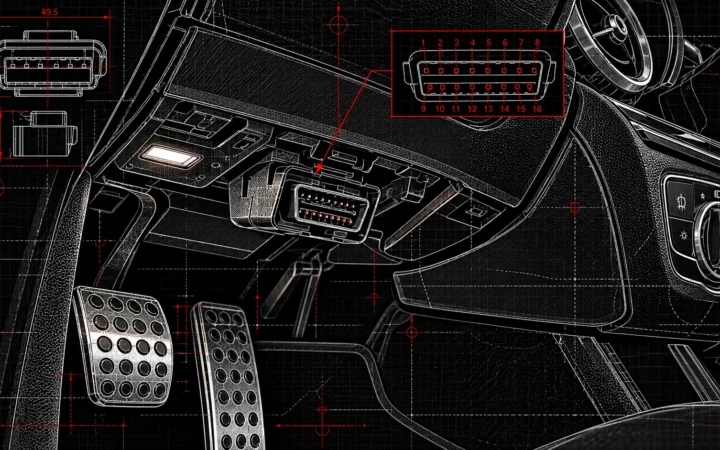
The module is a hand-held device prepared for your specific car. You connect it to the OBD-II port, activate the function and unplug it again, without a laptop or special tools. The right version depends on the chassis code, model year and market version of the car.
Cars with LED High Performance
LED High Performance headlights do not have individually controlled LEDs, so no software can give them partial high beam. Getting MULTIBEAM functions on such a car would mean different headlight units and matching software, which is a hardware retrofit rather than a setting.
That is also why the headlight type should be confirmed before ordering anything. If the equipment list is not at hand, the VIN settles the question, as explained in whether a MultiBeam module works with LED High Performance headlights.
Conclusion
LED High Performance, MULTIBEAM LED and DIGITAL LIGHT all use LEDs, but they differ in how precisely the car can control the beam. Only MULTIBEAM LED and DIGITAL LIGHT can keep the high beam on while dimming the area around other vehicles, and that is the function drivers notice most.
On many US-market cars the MULTIBEAM hardware is already installed while partial high beam is inactive. If you want to know what your car can do, start with the equipment list or VIN, then check the module for your chassis and year with the MWMods team.