
How to Turn Off ECO Start-Stop on a Mercedes and Keep It Off
Why Mercedes ECO start/stop turns itself back on after every start, and the options for keeping it off - from the ECO button to last mode modules.
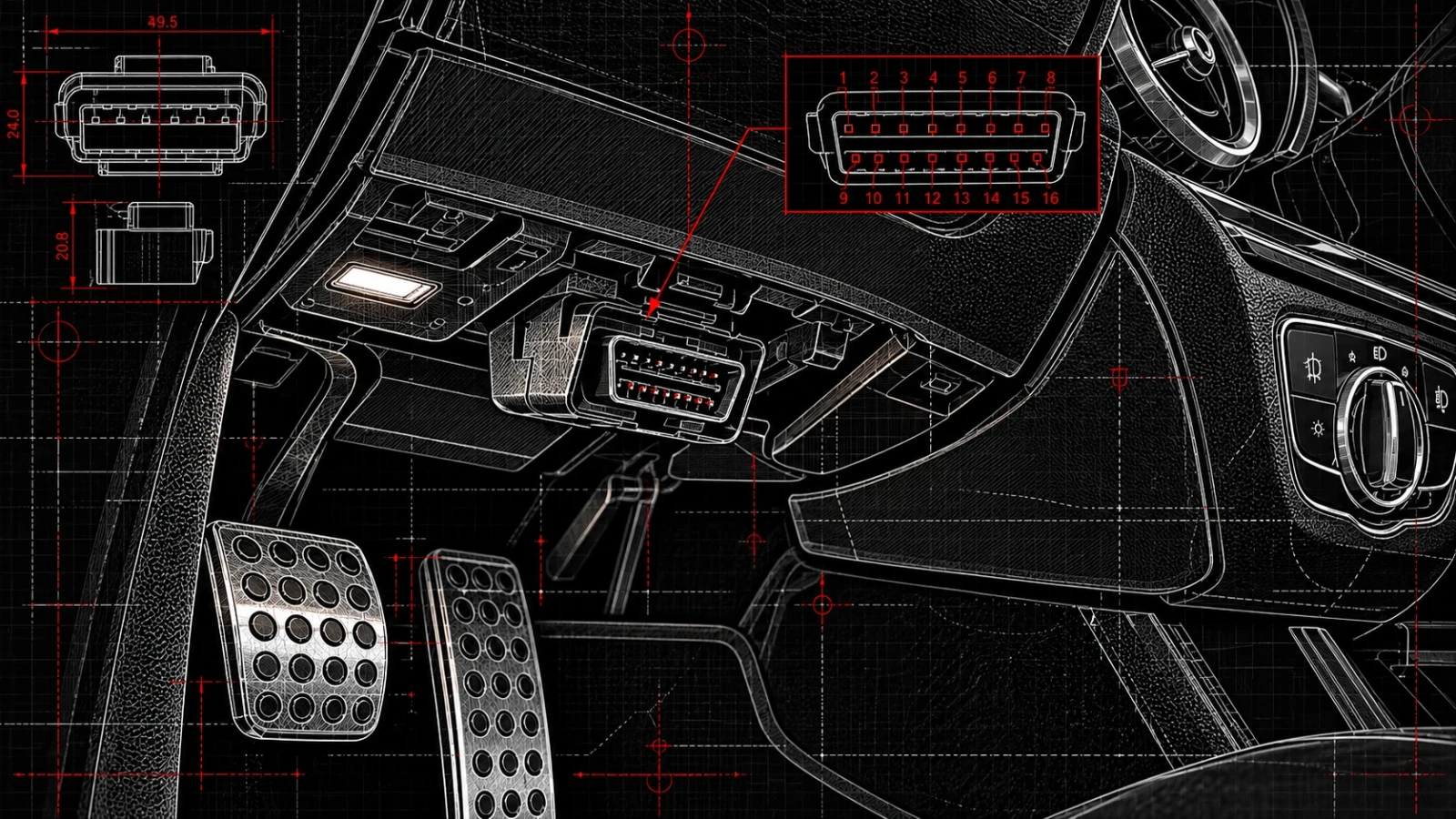
Table of contents
The engine stops at a red light, restarts when you lift your foot off the brake - and the next morning it does the same again, even though you switched the function off the day before. That is ECO start/stop on a Mercedes-Benz, and the reset after every start is the reason so many owners look for a way to keep it off.
Below: how the system decides when to stop the engine, why the ECO button does not stay off, what options exist for keeping it off, and whether doing so affects the car.
How ECO start/stop works
The idea is simple: an engine that is not running uses no fuel while the car waits at a light or in a queue. To make this work without the driver noticing too much, the system watches a number of conditions and decides on each stop whether switching the engine off makes sense. Because the decision is made anew at every stop, the same car may switch the engine off at one light and keep it running at the next.
Conditions for an engine stop
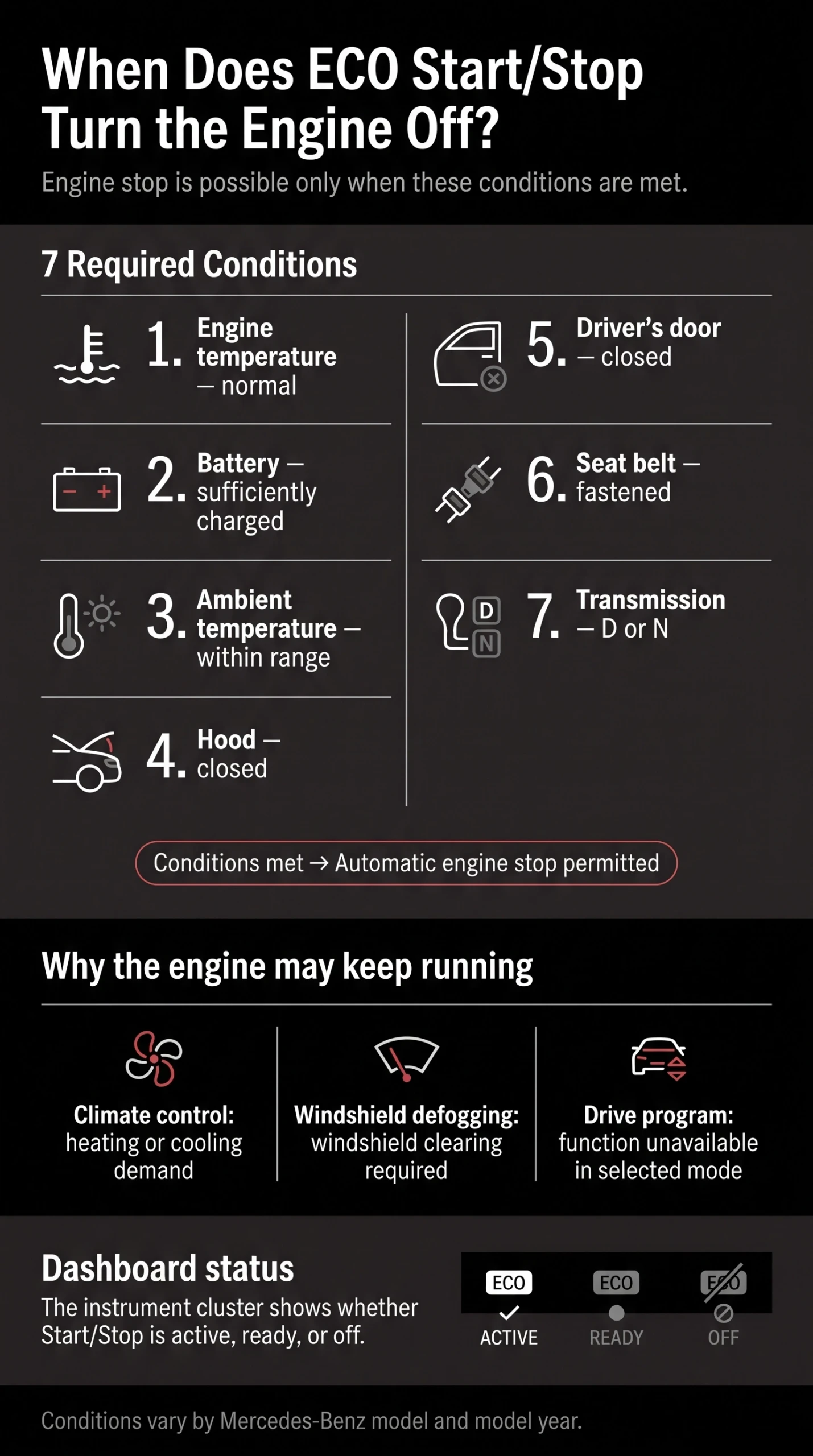
The system switches the engine off only when conditions allow it. According to the Mercedes-Benz owner's manuals, they include:
- the engine has reached normal operating temperature;
- the battery is sufficiently charged and the outside temperature is within the system's operating range;
- the hood is closed;
- the driver's door is closed, the driver's seat belt is fastened and the transmission is in D or N.
The engine may also keep running when the climate control needs it to heat or cool the cabin, when the windshield is fogging up, or in drive programs where the function is not available. A symbol in the instrument cluster shows whether the function is active, ready or switched off.
Restarting the engine
When you release the brake, or on some cars press the accelerator, the engine starts again and the car is ready to move. The restart is automatic and usually takes a moment, which some drivers notice when pulling away quickly from an intersection.
The engine can also restart by itself while the car is still standing, for example when the battery charge drops or the climate control needs more power. This is normal behavior and not a sign of a fault.
Cars with EQ Boost
Models with the 48-volt EQ Boost system use a starter-generator - integrated into the drivetrain on six-cylinder engines and belt-driven on some four-cylinder engines - which restarts the engine more smoothly and quietly than a conventional starter. The owner's manual lists the exact conditions for each engine.
The ECO button works the same way on these cars, and so does the reset after each start. For the driver, the main difference is how noticeable the restart feels, not how the function is switched on or off.
Why the system turns itself back on
The ECO button on the center console switches the function off, but only until the next start. With every new ignition cycle, ECO start/stop is active again, and most models offer no menu setting to change this. Drivers who do not want the engine to stop at every light have to press the button on every trip.
On some models the drive program plays a role too. Eco uses start/stop, while on some engines the function is not available in Sport. But DYNAMIC SELECT also returns to Comfort after each start, so choosing Sport is not a lasting solution either.
The reset is a software setting. That is why it can be changed, and why there are several approaches to keeping the function off, which differ in cost, effort and what stays in the car.
Ways to keep start/stop off
Beyond pressing the button every time, three approaches change how the car behaves at each start. They reach a similar result in different ways: one changes the car's software at a workshop, one adds a device that stays in the car, and one makes a single change with a device you unplug afterwards. The differences matter for the warranty, the effort involved and what stays in the car.
Coding with diagnostic software
A specialist with diagnostic software can change the start/stop setting in the car's control units. The result can be permanent, and nothing extra stays in the car once the change is made.
This route needs the right equipment or a workshop visit, and the person doing the coding needs to know the specific model. Any change to control unit settings is worth discussing with the dealer if the car is still under warranty.
Plug-in eliminators
Some devices stay connected permanently, usually to the OBD port or behind the button, and switch start/stop off electronically at every start, as if the driver had pressed the button.
They are easy to install and remove, but the device stays in the car for good, and the quality of such products varies. A device that stays plugged into the diagnostic port also needs to be removed before diagnostics at a workshop.
Last mode modules
The MWMods ECO start-stop last mode module does not remove the function. It changes the car's settings so that the system remembers its last state: if you switched start/stop off, it stays off after the next start, until you press the button again. Installation takes a few steps:
- Confirm compatibility with your VIN before ordering.
- Connect the hand-held module to the OBD-II port and apply the change.
- Unplug the module - nothing stays in the car.
The button keeps working as before, so the function can be switched back on at any time. Modules currently cost $240 to $300, depending on the model, and the right version depends on the chassis code, engine and model year.
Options compared
Side by side, the options differ less in the result than in what they ask from the owner:
| Option | How it works | Things to consider |
|---|---|---|
| Press the ECO button | Switches start/stop off for the current drive | Free, but needed every time the car starts |
| Drive in Sport | On some engines start/stop is not available in Sport | Changes throttle, shifting and fuel use as well |
| Coding | A specialist changes the setting in the control units | Needs equipment or a workshop visit |
| Plug-in eliminator | Stays connected and switches the function off at each start | Stays in the car; quality varies |
| Last mode module | The car remembers whether start/stop was off | One-time change; the button keeps working |
The first two options cost nothing but do not solve the reset. The other three do, and the choice between them comes down to whether you prefer a workshop, a device that stays in the car, or a one-time change you make yourself.
Start/stop, battery and starter
Cars with start/stop are built for frequent engine starts. They typically use a stronger starter and a battery designed for repeated starting, such as an AGM battery, so the system itself does not damage the car when it works as intended.
Keeping the function off is not known to cause damage either. The engine simply idles at stops like a car without the system, and the starter and battery are used less often. The trade-off is a little more fuel used in city traffic.
When the battery is eventually replaced, it should match the type the car was built with. That matters for start/stop cars whether or not the function is used, because the charging system is set up for that battery type.
Conclusion
ECO start/stop stops the engine only when temperature, battery and other conditions allow it, and the ECO button resets with every start, just like DYNAMIC SELECT. Pressing the button each time works but does not solve the reset.
Coding, plug-in eliminators and last mode modules can keep the function off; they differ in what stays in the car and how the change is made. If you prefer a one-time change that keeps the button working, the MWMods team can check which module fits your car.