AMG Menu in the Instrument Cluster: What It Shows and How Activation Works
What the AMG menu in a Mercedes-Benz instrument cluster shows, which cars with a digital cluster can get it and how the 63 and 43/53 styles differ.
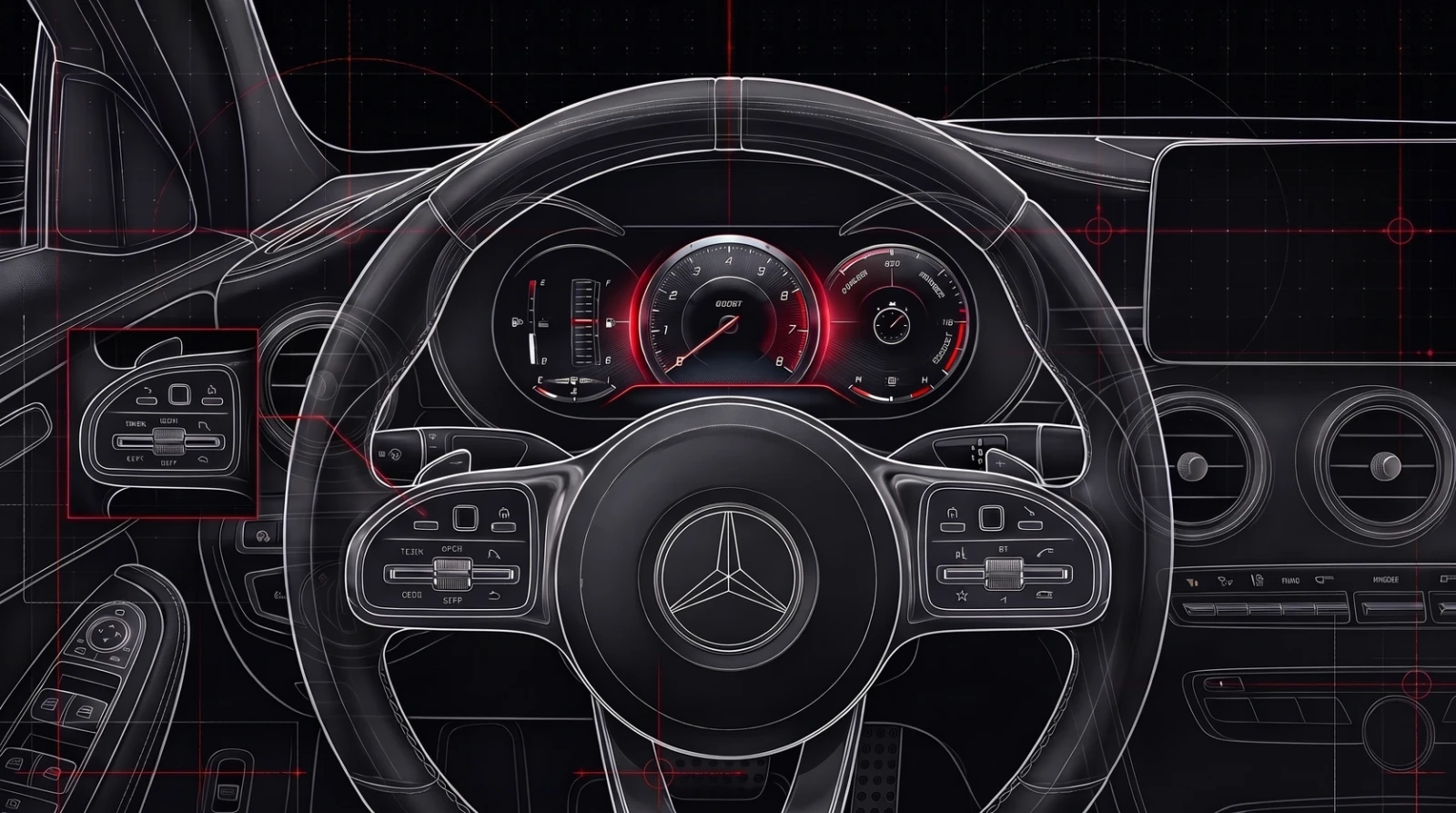
Table of contents
The AMG menu is one of the details that set a Mercedes-AMG apart from the regular models. Behind the steering wheel, the AMG car shows pages that the C 300 or E 350 next to it does not have: oil temperatures, boost pressure, power and torque, a lap timer. For many owners of non-AMG cars this is the part of the AMG they miss most in daily driving, more than the badge on the trunk.
On many newer models the difference is only software. The display is the same, and the AMG pages are simply switched off. This guide explains what the AMG menu shows, which cars can get it, how the two available styles differ and how activation works.
What the AMG menu is
The AMG menu is a set of pages in the instrument cluster, the display behind the steering wheel. The driver scrolls to it with the buttons on the steering wheel, just like to the trip computer or the assistance menu. On Mercedes-AMG models it comes from the factory, and it is one of the things that make an AMG feel different from the inside. Depending on the model, the factory AMG menu can also show the active DYNAMIC SELECT program and other engine data, so the exact set of pages varies even among AMG cars.
The cluster does not measure anything itself. It receives data from the engine and transmission control units over the car's network and decides which pages to show. On a regular Mercedes much of the same data is already there, because a C 300 also has an oil temperature sensor, a turbocharger and an automatic transmission. What is missing is the setting in the cluster that turns the AMG pages on.
That is why the AMG menu can be added without new hardware on cars where the cluster supports it. The change is made in the cluster's configuration, the same way the factory configures it for an AMG model. Nothing is installed, and the rest of the car keeps working exactly as before.
What the AMG menu shows
The exact pages depend on the car and on the style that is activated, but on compatible cars the AMG menu module adds the same four pages:
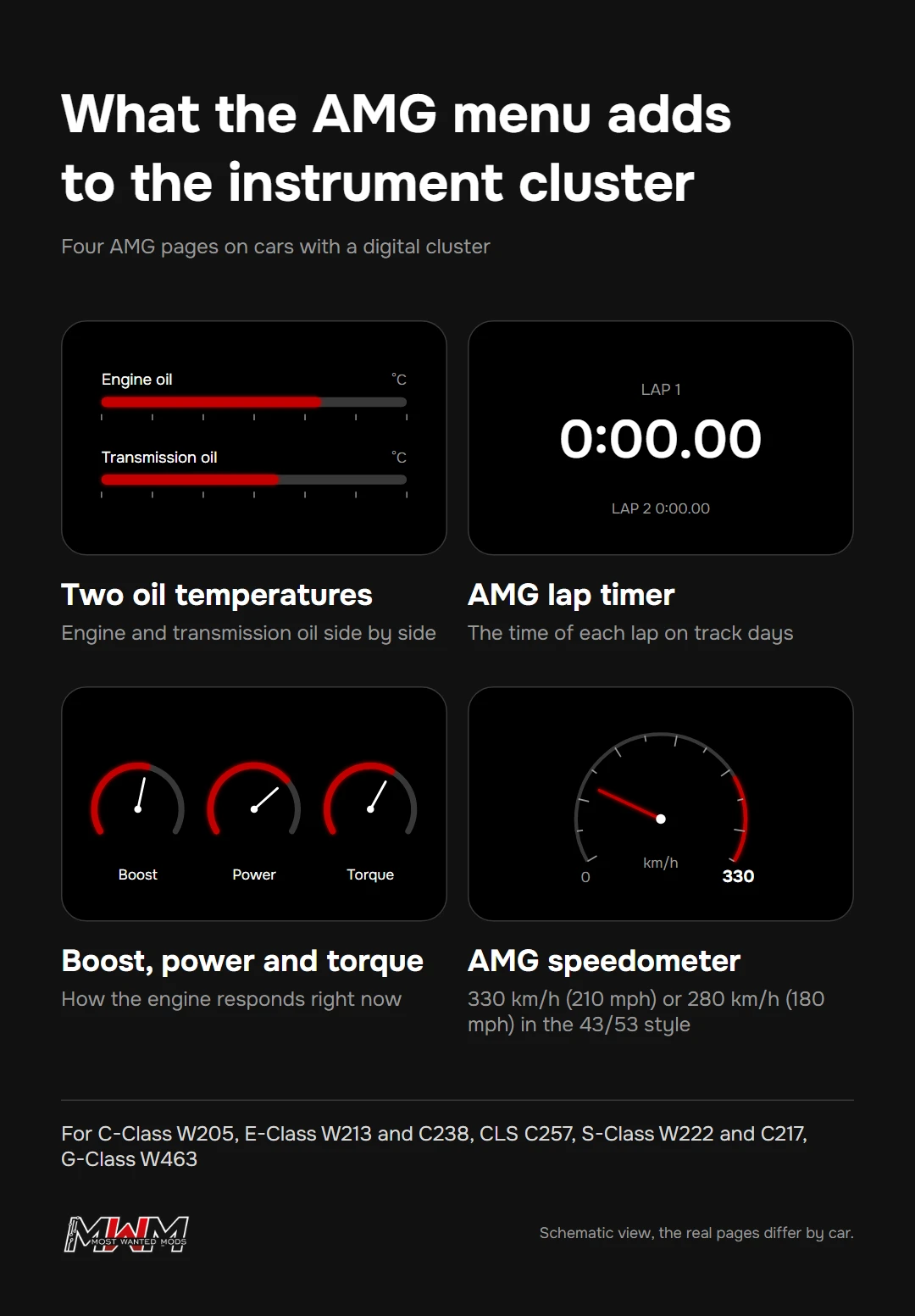
The oil temperatures are the page owners use most, and for a practical reason. A regular cluster shows only the coolant temperature, and coolant warms up faster than oil. When the coolant gauge has reached its normal position, the engine oil and especially the transmission oil are often still cool. The two readings show when the engine and the gearbox are actually ready for full throttle, which matters on every cold start, not only on a track.
The boost, power and torque page shows what the engine is doing at the moment: how much boost the turbocharger builds and how much power and torque the engine delivers as you accelerate. It is popular with owners who have had a Stage 1 tune, because it makes the change visible, but it is just as interesting on a stock engine to see how the car behaves in different drive programs.
The lap timer records the time of each lap and is meant for track days and driving events. The AMG speedometer changes the scale of the main dial to that of the matching AMG model, up to 330 km/h (210 mph) or 280 km/h (180 mph). It is the most visible part of the change, because it is in front of the driver all the time, not only when the AMG menu is open.
What the AMG menu does not change
The AMG menu is a display function, and it is worth being clear about what that means. It shows data the car already has, and it changes nothing in how the car drives. Some descriptions of AMG menu coding promise "more performance", but the engine output, the throttle response, the gearbox and the sound stay exactly as they were.
Owners who want the car to feel more like an AMG usually combine the menu with other changes, each of which works on its own:
- more power and torque come from an engine tune, such as a Stage 1 tune;
- how the car reacts in each drive program is set by DYNAMIC SELECT;
- a louder sound in every program comes from exhaust flap selection on cars with a factory flap exhaust.
The AMG menu fits well with all of them, because it shows their effect: the boost and power page after a tune, the oil temperatures before you use the extra power. On its own, it is a change of information and look, and it is priced accordingly.
Which cars can get it
The AMG menu needs a digital instrument cluster, the full screen behind the steering wheel instead of analog dials. The cluster type is tied to the chassis code, the model year and the equipment, so two cars of the same model can differ. The MWMods module range covers these generations.
The C-Class W205 qualifies from the facelift onward, when the digital cluster became available, and the range covers the C 200, C 250, C 300, C 400 and the plug-in hybrid C 350e. The E-Class W213 sedan and the C238 Coupe and Cabriolet are covered from the E 200 to the E 450, together with the E 43 and E 53.
The CLS C257 is covered from the CLS 300d to the CLS 450 and the CLS 53, the S-Class W222 and C217 after the facelift with the S 450 and S 560, and the G-Class W463 with the G 350d. On the AMG 43 and 53 models the menu already exists, and the module switches them to the 63 style.
The current range does not include the newest generations with the second MBUX, such as the C-Class W206 and the E-Class W214. So the fact that a newer car has a digital display does not mean an AMG menu module exists for it, and the VIN check comes first here too.
Many searches name older cars, especially the C-Class W204 and the E-Class W212. These generations use analog dials with a small screen between them, not a digital cluster, so they are outside the module range. For any car the safest check is the VIN: it shows which cluster was actually fitted, and MWMods explains why the VIN is needed before an order.
How to tell if your car has a digital cluster
On some models, including the W205 C-Class, the digital cluster was optional, so two cars of the same model and year can have different displays. Before looking at any AMG menu module, it is worth checking which one your car has. A minute with the ignition on is enough:
- A digital cluster is one continuous screen behind the steering wheel. The speedometer and rev counter are drawn on it, and there are no physical needles.
- An analog cluster has two round dials with real needles and a smaller color screen between them.
- On a digital cluster the whole layout can be changed in the settings, not only the information in the middle.
If the screen behind the wheel looks digital but you are not sure, the VIN settles it. The equipment list behind it shows exactly which cluster the car left the factory with, and that is the same check MWMods makes before preparing a module. Two cars that look identical from the outside can differ here, which is why a photo of the dashboard alone is not enough.
AMG 63 style or AMG 43/53 style
Most cars can get the AMG menu in one of two styles, named after the AMG models they copy. The menu itself is the same in both: two oil temperatures, the lap timer and the boost, power and torque screen. The difference is the speedometer scale.
The AMG 63 style uses the scale of the V8 models, up to 330 km/h or 210 mph. The AMG 43/53 style uses the scale of the six-cylinder AMG models, up to 280 km/h or 180 mph. On US cars the cluster shows miles per hour, so the relevant numbers are 210 and 180.
The choice is a matter of taste. The 43/53 style matches the six-cylinder AMG models built on the same platform, while the 63 style gives the full V8 look. Not every car offers both: for the G-Class, the CLS and the S-Class the range has only the 63 style.
How activation works
Activation changes the cluster's configuration, so the method matters less than doing it correctly for the specific car. With the MWMods module it takes a few steps, and a battery in good condition matters, because a voltage drop can interrupt the process:
- Send your VIN. It confirms that your car has a supported digital cluster and shows which style is available.
- The module is prepared for your car and shipped to you.
- Switch the ignition on with the engine off, plug the module into the OBD-II port under the dashboard on the driver's side and activate the change. No laptop or other tools are needed.
- Unplug the module and scroll to the new AMG pages with the steering wheel buttons.
The module does not stay in the car after the change. You keep it, and if you want the original cluster back, for example before selling the car, you can return to the factory settings with the same module.
After the activation, the AMG pages appear among the other cluster menus. You reach them with the steering wheel buttons in the same way as the trip computer or the assistance menu, and the new speedometer scale is visible as soon as the car is switched on. Nothing else in the car's menus changes.
The other route is coding at a workshop with dealer diagnostic equipment, where a specialist changes the same setting by hand. Whichever way it is done, a later software update at a dealer can write the factory configuration back into the cluster. Our guide to Mercedes coding explains why this happens and why the setting can simply be applied again.
Price and what to check before ordering
An AMG menu module from MWMods costs $260 or $300 for one car, depending on the chassis and the style. The price includes the activation for that car.
Before ordering, three things are worth checking. First, the cluster: the car needs the digital cluster, which the VIN confirms. Second, the style: decide between the 63 and the 43/53 speedometer, if your car offers both. Third, the other changes you plan: several MWMods functions can be written to one module, and for an order of five or more the module itself is free.
It also helps to plan around dealer visits. A software update of the cluster at a dealer can bring the factory pages back, so keep the module after the activation: with it, the AMG menu can be applied again in a few minutes. Workshop coding is the alternative, and it is priced by each workshop, so the total depends on where you go and whether the change has to be repeated after a later update.
The AMG cluster menu modules are listed by chassis and model, so you can find the exact version for your car and send the VIN for confirmation before you pay.
Conclusion
The AMG menu is a software function of the digital instrument cluster. On compatible Mercedes-Benz models it adds the pages of an AMG car: engine and transmission oil temperatures, a lap timer, a boost, power and torque screen and an AMG speedometer, without new hardware.
Whether your car can get it depends on the cluster, and the VIN answers that question in advance. The choice between the 63 and the 43/53 style comes down to the speedometer you prefer, and the change can be reversed at any time.